The overwhelming majority of the feedback I get about XWord Info is supportive and complimentary, and that keeps me going after nearly two decades. But like Will Shortz who used to start his ACPT talks by reading complaints he received in mail, I thought it would be fun to look back at some categories of contrary opinions.
Here’s a brief history of “How XWord Info is Ruining Crosswords.”
You’re helping people cheat
When I started the website back in 2007, crosswords were available in the newspaper, or in downloadable encrypted Across Lite files. Either way, the answers weren’t revealed until the next day, when you either bought another paper or got the unlock code.
Or (and you kids will just have to believe me on this), you could dial 1-900-289-CLUE and for $1.49 a minute, get some answers. Apparently, the NYT made a decent amount of money on that.
Before I started the Wordplay column, I had a personal blog where I would solve the puzzles myself (often correctly!) and post my solutions there and on my new website xwordinfo.com. I hadn’t realized at the time that two established bloggers were already posting solutions. Amy Reynaldo and Michael Sharp were blogging a year before I started. Perhaps they got chastised too, so maybe we were all ruining crosswords by helping people cheat.
Too much data ruins it for constructors
“Nobody will remember if a similar theme ran three years ago, except now that people can easily search old puzzles, uniqueness suddenly is more important. Nobody knew how many times OREO has been used this year, but now everyone complains about it.”
You encourage BAD crosswords
Because I track curiosities like pangrams and low block counts and stacks, it is seen as encouraging people to create those monstrosities. “These, and other stunt puzzles, are awful because the constructors are just showing off and it’s not supposed to be fun for the constructor, just for me the solver. Also, I hate rebus puzzles.”
I’ve never quite understood this. If pushing those boundaries delights constructors, I say go for it. I think they’re fun. I’m not alone.
The home page is too confusing
Yep, you got me on that one. And as new features get added over time, it gets worse and worse.
Your constructor tools destroy the art of making crosswords
You’ve probably heard commentors bemoan themes that might have come from “databases” or “algorithms” or “listicles”. XWord Info contributes to this disaster too.
The Finder Page lets you discover words that contain 3 double letters or phrases that contain the word LOVE or words whose only vowel is E or 7-letter words that are other words when reversed. My Advanced Finder Tips page has many more examples. Would crosswords be better if such tools never existed?
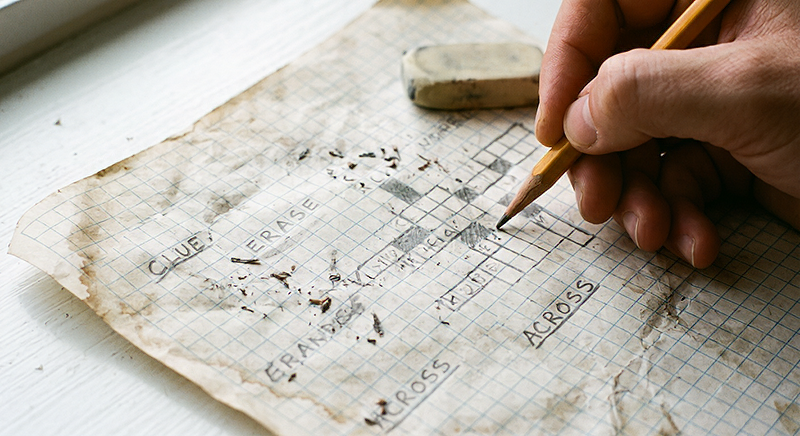
Not long ago, the available tools were graph paper, pencil, eraser, dictionary, atlas, book of quotations, the complete works of Shakespeare, and the Bible. Every advance since the rise of personal computers has been controversial. When construction software first invented the Auto-Fill option, it was a sign of the Apocalypse.
Sure enough, Auto-Fill did result in some crappy crosswords being published. You might remember a scandal at USA Today. Still, it’s hard to argue fill overall hasn’t improved since the Maleska era.
Aside: if you haven’t watched the first video of the great Garson Hampfield, well you must.
You only support one publication
True. Other tools on the Internet have data across all the main American sources, but XWord Info only knows about The New York Times. I originally tried to get permission from other venues, and even one prominent Indie constructor, but I was either denied or ignored. The NYT was very enthusiastic about XWord Info from the beginning. I suspect its existence helped me get a freelance job with them.
In retrospect, it’s just as well I couldn’t include other sources. XWord Info is messy enough without even more data.
You push a harmful binary view of gender
XWord Info is unique in a few ways. It carefully curates an archive going back to 1942. It gives Variety puzzles equal status to crosswords. But most importantly, it focuses on the people who create the puzzles. Data is organized by constructors, taking care to track name changes, etc.
Women are under-represented as constructors, and a few years ago, a prominent blogger wondered if the proportions were even improving. Well, I have a database so I foolishly thought I could tackle that question. My data is ternary rather than binary: I classify constructors into ones who identify as female, ones who identify as male, and “other”. That final category means anything from unknown to none of the above to would rather not say.
I’m on record as saying this is the one stat I regret adding. Constructors were offended if I asked their preference. They were offended if I didn’t ask. They were offended if I didn’t let them alter their status on their own when feelings evolved.
The Women constructors page is still there because enough other people have told me they appreciate it.
You are culturally insensitive!
Guilty, although I do try to learn and improve.
It’s hard to express any opinion on the Internet without offending someone. J K Rowling is heroic for getting an entire generation to care about reading novels. She’s evil because she espouses vile views. If you say you don’t have an opinion or you can see both sides, you offend everyone.
Seemingly benign comments can be offensive. Saying a puzzle was hard because you were unaware of some of the references exposes you as a cretin whose narrow views hurt people who care deeply about them. Scoring a word too high or too low causes angst.
In every such case, I strive to broaden my knowledge and understanding, and I make almost all requested changes, but it’s impossible to make everyone happy.
You are contributing to humanity’s demise
We finally get to AI. There’s nothing I can say here that won’t be controversial or even infuriating. I get that. I completely understand the reticence and disgust and even fear. AI has a lot of truly awful consequences.
Let’s start with some background.
The first most people encountered AI in crosswords was at the 2012 American Crossword Puzzle Tournament where a program called Dr. Fill written by the researcher Matt Ginsberg competed unofficially against the human solvers. It came in 141st in the standings.
That intrigued some people and freaked others out. Even worse for that latter group, Dr. Fill continued to improve and slide up in the rankings, eventually being the virtual winner in 2021, at which point both Dr. Fill and Dr. Ginsberg retired from crosswords.
I was in the intrigued category. After all, crosswords are designed to be cleverly deceptive. How could a machine handle that?
I didn’t personally get involved with AI until 2023 when, like most programmers, I started using it to help me find and fix bugs. Back then, AI was interesting but often useless. Like Dr. Fill, it improved dramatically for software developers. I can’t imagine coding anything complex without it now. I wondered if AI could help with a common request I get: “Tell me if something similar to this theme idea has been used before.”
I didn’t add any AI to XWord Info data itself until 2026, and immediately, I started getting feedback. Some people just wanted to chastise me. Some cancelled their accounts.
An all-out ban on AI is tough today. If you’re a crossword constructor who wants to avoid it completely, you can’t use Google, or spelling or grammar checkers, and probably your construction software of choice. You’re back to graph paper.
The New York Times policy
NYT published a new policy on use of Generative AI tools that you should read. You can use AI for research, but “generative AI” is prohibited.
I can’t speak for the Times, but they seem to have two legitimate concerns:
- There is a value in human vs. machine generated content. Of course! Even if a casual or even expert reader can’t tell the difference, this strikes me as an important principle.
- Content humans create shouldn’t be used by AI itself. NYT wants you to go to their site to read their news and opinions. On a broader scale, if AI can reproduce or summarize information from legitimate sources, those sources will struggle to even survive.
I’ve tried to stay within NYT’s guidelines. On point 1, XWord Info doesn’t provide generative AI (unlike, say, your Auto-Fill button that absolutely does generate content), but it does provide a way for you to analyze your crossword. On the second point, the prompt I create when you use XWord Info to analyze your crossword prohibits the AI from using your content to train or improve AI models.
Is that enough? I think so, but I don’t get to decide. For now, the safe path is to avoid XWord Info AI Analyze for puzzles you plan to submit to the Times, but you can read their guidelines and decide for yourself.
AI already knows a lot about crosswords, mostly from blogs. It uses terms like freestyle coined by Amy, or Natick invented by Michael. There are dozens of click-bait sites on the internet with complete clue and answer databases for AI to scour. It can’t scour XWord Info because most pages there require authentication and all are rate-limited, but there are many more convenient sources.
Is AI analysis of crosswords even useful?
Great question. Not really. At least not always. It’s poor at understanding clever jokes. It will sometimes whine about the best clues and praise the worst ones. It often misunderstands a theme and then complains that it’s bad.
It’s not totally useless, though. It can point out typos, unintended dupes, awkward crossings, and even some factual errors. It might have opinions about whether clues are fair or possibly offensive. Any of these opinions might be completely wrong. The trick is to consider the ones that seem right and ignore the ones that feel bogus. The main value for me is that I find it interesting to see what AI can do with a puzzle designed to deceive humans.
AI is also helpful for looking at crosswords from the 1940s and 1950s. It’s good at placing itself at the exact moment the puzzle was published, so it can explain cultural or historical references modern solvers might not understand. I’ve also used it to find transcription errors in some early hand-digitized crosswords.
I have more complaints you haven’t covered here
Keep those cards and letters coming. I always appreciate hearing from crossword enthusiasts.
By the way, I haven’t yet provided a way to tell you if your theme is unique. A project still in the future.